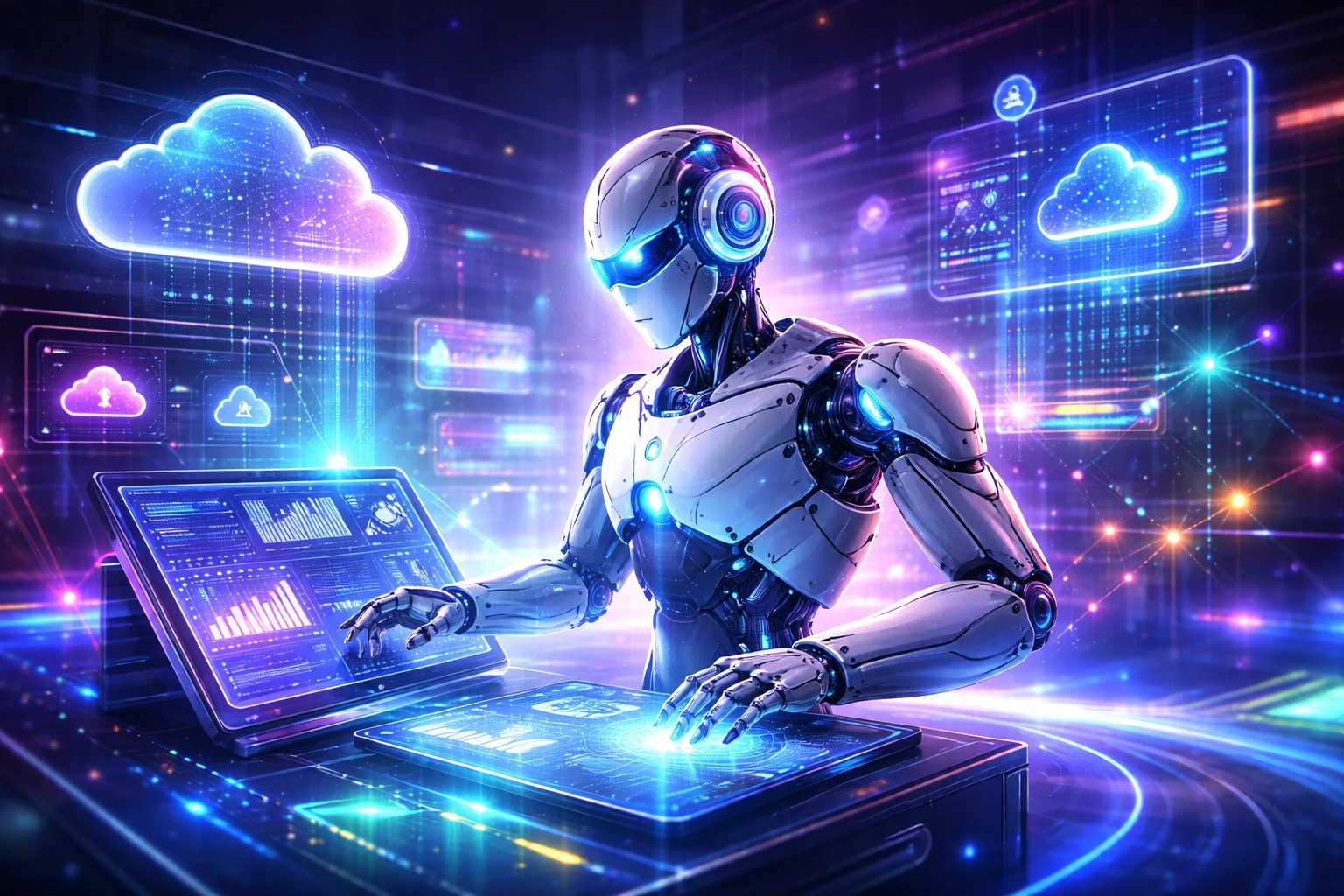


40% Apps Will Use AI Agents by End of 2026
The Rise of AI Agents in Modern Software
The software industry is entering a defining moment where AI agents are no longer experimental features but core components of modern applications. According to recent forecasts, nearly 40% of enterprise applications are expected to integrate AI agents by the end of 2026, marking a massive shift in how software is designed, deployed, and experienced. This transition is not just another trend cycle. It represents a structural transformation in the SaaS ecosystem, where automation evolves into autonomy and software begins to act rather than simply respond.
Unlike traditional automation tools, AI agents are capable of decision-making, task execution, and contextual understanding. They operate independently within defined parameters, handling workflows that previously required human intervention. This shift is driven by advancements in large language models, multimodal AI, and cloud-native architectures that enable real-time intelligence at scale. As a result, companies are rethinking how their platforms function, moving from static systems to dynamic, adaptive environments.
For SaaS Vortixel and similar platforms, this signals a major opportunity. Businesses are no longer looking for tools that simply assist; they want systems that actively solve problems, predict outcomes, and optimize operations automatically. This demand is accelerating the adoption of AI agents across industries, from customer support and finance to product management and cybersecurity.
What Are AI Agents and Why They Matter
At their core, AI agents are autonomous software entities that can perceive data, make decisions, and execute tasks without continuous human input. They combine machine learning, natural language processing, and workflow orchestration to perform complex operations in real time. Unlike basic scripts or bots, AI agents can adapt to changing conditions and learn from interactions, making them significantly more powerful and scalable.
The importance of AI agents lies in their ability to transform software from passive tools into active collaborators. Instead of waiting for user commands, these systems can anticipate needs, trigger actions, and deliver results proactively. This fundamentally changes the relationship between users and technology. Software becomes less about interfaces and more about outcomes.
There are several types of AI agents emerging in the SaaS space:
- Task-specific agents that handle repetitive workflows such as data entry or report generation
- Conversational agents that manage customer interactions with human-like responses
- Decision-making agents that analyze data and recommend or execute business strategies
- Multi-agent systems where several AI agents collaborate to complete complex processes
Each of these plays a role in reshaping how applications are built and used. The projection that 40% of apps will adopt AI agents reflects not just technological capability but also a shift in business priorities toward efficiency, scalability, and intelligent automation.
Why 2026 Is the Tipping Point
The forecast for 2026 is not arbitrary. Several key factors are converging to make this year a turning point for AI-powered SaaS.
First, the cost of deploying AI has decreased significantly. Cloud providers now offer scalable AI infrastructure that allows companies to integrate advanced models without massive upfront investment. This democratization of AI technology means that even mid-sized startups can build intelligent systems that rival enterprise-level solutions.
Second, user expectations have evolved. Modern users expect software to be fast, intuitive, and intelligent. Static dashboards and manual workflows are no longer sufficient. Businesses that fail to adopt AI-driven features risk falling behind competitors that offer smarter, more efficient solutions.
Third, the competitive landscape is forcing rapid innovation. As more companies integrate AI agents into their products, others are compelled to follow. This creates a feedback loop where adoption accelerates across the entire industry.
Finally, regulatory frameworks around AI are becoming clearer. Governments and organizations are establishing guidelines for ethical AI usage, data privacy, and transparency. This reduces uncertainty and encourages businesses to invest in AI technologies with greater confidence.
Together, these factors create the perfect environment for AI agents to move from niche applications to mainstream adoption.
How AI Agents Are Transforming SaaS Platforms
The integration of AI agents in SaaS platforms is reshaping every aspect of software development and usage. One of the most significant changes is the shift from user-driven workflows to system-driven automation. Instead of users navigating complex interfaces, AI agents handle tasks behind the scenes, delivering results with minimal input.
In customer support, for example, AI agents can resolve inquiries instantly by analyzing context, retrieving relevant data, and generating accurate responses. This reduces response times and improves customer satisfaction while lowering operational costs.
In product management, AI agents can analyze user behavior, identify trends, and recommend feature improvements. This enables teams to make data-driven decisions faster and more effectively. Similarly, in finance, AI agents can automate processes such as fraud detection, expense tracking, and financial forecasting.
Another major impact is on software scalability. AI agents allow applications to handle larger volumes of data and users without proportional increases in resources. This makes it easier for businesses to grow without being constrained by operational limitations.
Moreover, AI agents enable personalization at scale. By analyzing user data in real time, these systems can tailor experiences to individual preferences, increasing engagement and retention. This level of customization was previously difficult to achieve without significant manual effort.
The Business Impact of AI Agent Adoption
The adoption of AI agents is not just a technical upgrade. It has profound implications for business strategy and operations. Companies that successfully integrate AI agents can achieve significant improvements in efficiency, productivity, and profitability.
One of the most immediate benefits is cost reduction. By automating repetitive tasks, businesses can reduce the need for manual labor and allocate resources more effectively. This leads to lower operational costs and higher margins.
At the same time, AI agents enable faster decision-making. By analyzing data in real time, these systems provide insights that help businesses respond quickly to changing conditions. This agility is crucial in today’s fast-paced market environment.
Another key advantage is improved customer experience. AI agents can provide instant support, personalized recommendations, and seamless interactions, creating a more engaging and satisfying user journey. This can lead to increased customer loyalty and higher lifetime value.
For SaaS providers, the integration of AI agents also opens new revenue opportunities. Companies can offer premium features, subscription tiers, or usage-based pricing models centered around AI capabilities. This not only diversifies revenue streams but also positions the product as a cutting-edge solution in a competitive market.
Challenges and Risks in AI Agent Integration
Despite the many benefits, integrating AI agents into applications is not without challenges. One of the primary concerns is data privacy and security. AI agents rely on large amounts of data to function effectively, which raises questions about how this data is collected, stored, and used.
Another challenge is ensuring the reliability and accuracy of AI systems. While AI agents can perform complex tasks, they are not infallible. Errors or biases in the underlying models can lead to incorrect decisions or unintended consequences. This makes it essential for businesses to implement robust monitoring and validation mechanisms.
There is also the issue of user trust. As software becomes more autonomous, users may feel uneasy about relinquishing control to AI systems. Building trust requires transparency, clear communication, and the ability for users to override or customize AI behavior.
Additionally, integrating AI agents can be technically complex. It requires expertise in machine learning, data engineering, and system architecture. Companies must invest in the right talent and infrastructure to successfully implement these technologies.
The Future of SaaS in an AI Agent World
Looking beyond 2026, the role of AI agents in SaaS is expected to continue expanding. As technology advances, these systems will become more sophisticated, capable of handling increasingly complex tasks and collaborating with other agents in multi-agent ecosystems.
One of the most exciting developments is the concept of fully autonomous software platforms. In this model, AI agents manage entire workflows from start to finish, requiring minimal human intervention. This could revolutionize industries by drastically reducing the time and effort required to complete tasks.
Another trend is the integration of AI agents with emerging technologies such as the Internet of Things (IoT), blockchain, and augmented reality. This will create new possibilities for innovation and enable more interconnected and intelligent systems.
For businesses, the key to success in this new landscape will be adaptability. Companies must be willing to experiment, learn, and evolve as AI technology continues to advance. Those that embrace this change will be well-positioned to lead in the next era of software.
Conclusion: A New Era of Intelligent Applications
The prediction that 40% of applications will use AI agents by the end of 2026 is more than just a statistic. It is a signal that the software industry is undergoing a fundamental transformation. AI agents are redefining what applications can do, how they operate, and how users interact with them.
For SaaS Vortixel and other forward-thinking platforms, this is a moment of opportunity. By embracing AI-driven automation and intelligent systems, businesses can unlock new levels of efficiency, innovation, and growth. The shift toward AI agents is not optional. It is inevitable.
As we move into this new era, one thing is clear: the future of software is not just smart. It is autonomous, adaptive, and deeply integrated into every aspect of business and daily life.