
AI Customer Support Enters the Operator Era
AI customer support is moving into a new phase, and Fin Operator is one of the clearest signs that the help desk is no longer just a queue where tickets wait their turn. For years, SaaS teams treated automation like a faster front door: a chatbot answered basic questions, routed complex issues, and handed people over to human agents when the conversation got too messy. That model made sense when AI was mostly reactive, but the new customer support stack is becoming more active, more layered, and more operationally aware. Fin Operator points toward a world where one AI system does not simply talk to customers, but also helps manage the AI agent that is doing the talking. In other words, the future of support may not be humans versus AI, but humans, AI agents, and operator agents working together inside one evolving service machine.
The idea sounds almost futuristic at first: an AI agent built to supervise another AI agent. Yet it fits perfectly with where SaaS is heading in 2026, especially as companies realize that customer service automation is not just about cutting response times. Once AI begins handling a large share of conversations, the real challenge shifts from “Can the bot answer?” to “Can the system improve, audit, adapt, and stay aligned at scale?” That is where Fin Operator becomes interesting, because it suggests that the next big layer in AI customer support will be operational intelligence. Instead of forcing support managers to manually review every weak answer, chase every failed escalation, and scan every trend by hand, operator-style AI can surface what matters and help teams act faster.
Why Fin Operator Feels Bigger Than Another AI Feature
Most SaaS product launches arrive with familiar language about productivity, automation, and better workflows. Fin Operator stands out because it reflects a deeper shift in how AI-native software products are being designed. Traditional help desk tools were built around human agents, with AI added later as a feature layer on top of tickets, macros, and dashboards. Fin Operator flips that logic by treating the AI agent as a primary worker inside the support operation, then creating another layer to help manage its performance. That shift matters because once the AI agent becomes part of the daily workforce, it needs monitoring, coaching, quality checks, and operational direction just like any other service function.
This does not mean human support teams disappear from the picture. In fact, the more realistic reading is that human roles become more strategic, because someone still has to define policies, approve sensitive changes, understand customer emotion, and own the brand experience. But the workload around those responsibilities can change dramatically when an operator agent can detect problems, flag patterns, and recommend improvements. In a normal support environment, managers often spend hours finding the signal hidden inside thousands of conversations. In an operator-led support environment, the system can push the right issues forward before they become a bigger problem.
That is why the phrase AI customer support no longer describes only the visible chatbot window on a website. It now includes the invisible operational layer behind that window, where teams manage accuracy, tone, compliance, knowledge quality, incident response, and escalation logic. SaaS companies that understand this distinction will be better prepared for the next wave of customer service competition. The winners will not simply be the tools that answer the most questions automatically. They will be the platforms that help businesses trust, improve, and govern automated service at scale.
The Rise of AI Managing AI in Customer Support
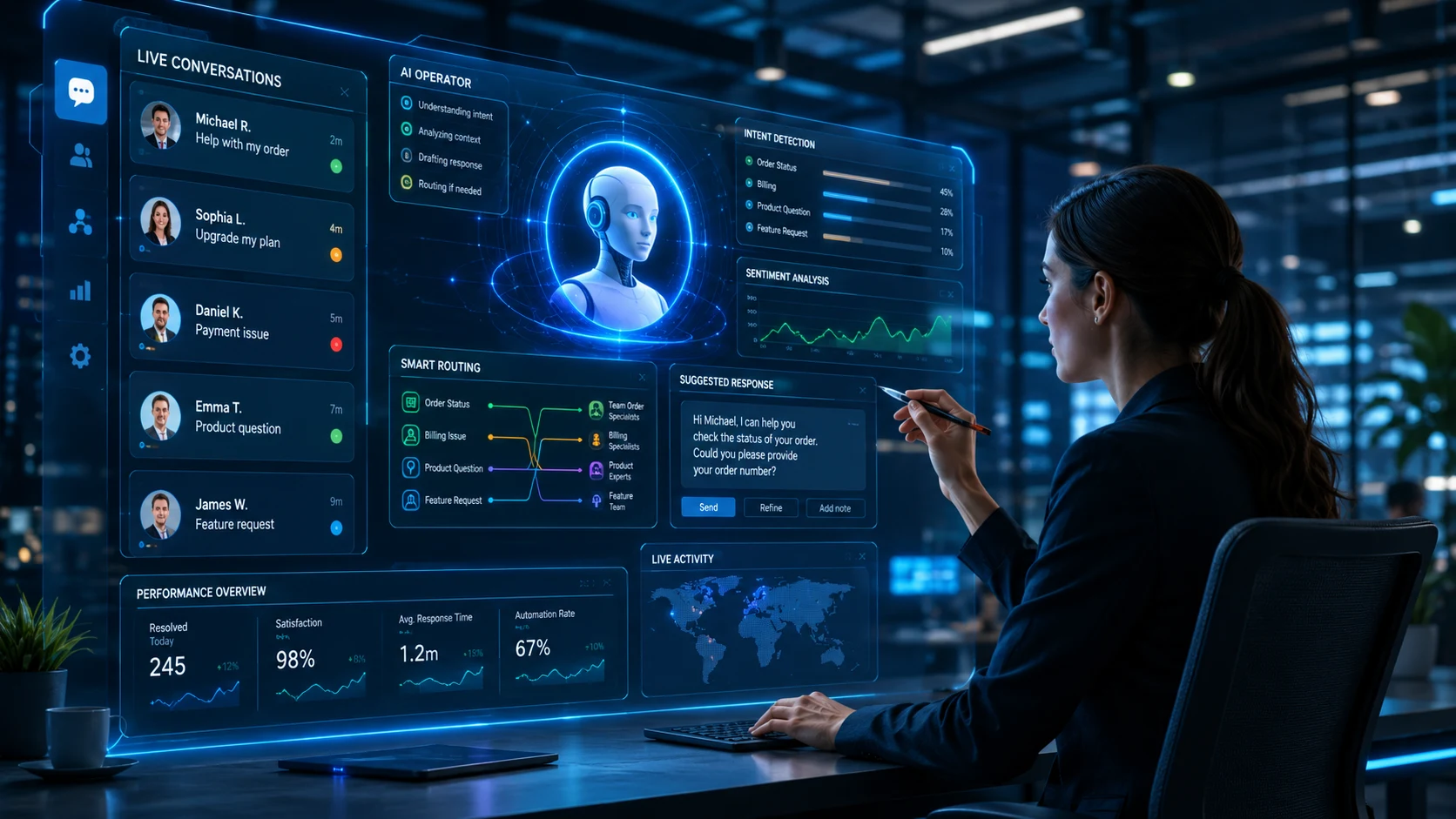
The most important idea behind Fin Operator is not that AI can answer customers, because that story is already well known. The more important idea is that AI can now help manage the work of AI itself. This creates a new operating model for SaaS teams that have already moved beyond basic chatbot experiments. Once a company has thousands or millions of automated conversations happening across chat, email, and other channels, human review alone becomes too slow. A second AI layer can scan performance, detect recurring failure points, and help support leaders understand where the system needs attention.
This is a major difference from the earlier wave of automation, where most tools were judged by whether they could deflect tickets. Deflection was useful, but it also created anxiety because customers often felt trapped inside rigid flows. Modern AI customer support has to do more than reduce volume; it has to maintain quality, understand context, and improve continuously. If a customer-facing agent gives a weak answer, the business needs to know why it happened and how to prevent the same mistake later. Fin Operator represents the growing need for a control layer that does not just observe AI performance, but helps the organization turn support data into action.
The concept also mirrors what is happening across the broader SaaS world. Companies are adding AI agents to sales, finance, IT, HR, security, and product operations. As these agents multiply, the next problem becomes agent management, because every automated worker needs boundaries, data access, evaluation, and accountability. Customer support is one of the first places where this challenge becomes obvious because the conversations are constant, public-facing, and emotionally sensitive. If an AI agent fails in customer support, the result is not just a bad internal workflow; it can become a frustrated customer, a churn risk, or a brand trust issue.
How Fin Operator Changes the Support Team Workflow
In a classic support team, managers often spend their day switching between dashboards, tickets, conversation reviews, knowledge base updates, team coaching, and customer escalations. That work is important, but much of it is repetitive and reactive. A manager may not discover a broken help article until several customers complain about the same confusing answer. A team lead may not notice that an AI agent is struggling with a specific product area until resolution rates dip. Fin Operator changes the workflow by making operations more proactive, because it can help surface issues as they emerge rather than waiting for a manual review cycle.
This is especially valuable for SaaS companies with fast-changing products. When features ship every week, pricing pages change, onboarding flows evolve, and product names get refreshed, the support knowledge layer can become outdated quickly. An AI support agent is only as useful as the knowledge, rules, and workflows behind it. If the company’s documentation is incomplete or inconsistent, the AI may answer confidently but miss important context. Operator-style AI helps close that gap by turning support operations into a living system that can detect weak spots and guide improvement.
The practical impact is that human support leaders can spend less time hunting for problems and more time making decisions. Instead of opening random conversations to check quality, they can focus on the conversations that matter most. Instead of guessing which help articles need updates, they can see where customers keep getting stuck. Instead of treating AI performance as a black box, they can work with a system that explains patterns and suggests next steps. This makes AI customer support feel less like an outsourced chatbot and more like an integrated operating system for customer experience.
Why This Matters for SaaS Companies
For SaaS companies, customer support is not just a cost center anymore. It is part of retention, onboarding, expansion, product education, and brand trust. A frustrated customer who cannot get a clear answer may not open another ticket; they may simply cancel, downgrade, or move to a competitor. That is why the new support race is not only about faster responses. It is about delivering accurate, personalized, and consistent help while keeping the operating cost under control.
Fin Operator fits into this pressure point because SaaS companies are being pushed from both directions. Customers expect instant answers, but they also expect those answers to be useful, human-aware, and connected to their actual account context. Support teams need to scale, but hiring more agents for every growth phase can become expensive and inefficient. Executives want automation, but they also want governance because careless AI can create brand, compliance, and customer trust risks. A platform that can automate the front line and assist the back office becomes far more valuable than a tool that only handles simple replies.
This is why the operator model could become a major SaaS category signal. In the past, customer support software competed on ticketing, inbox design, integrations, and basic automation. Now the competition is shifting toward AI performance, agent orchestration, knowledge intelligence, and operational control. A support platform that cannot help teams manage AI may start to feel outdated, even if its ticketing features are polished. As more businesses adopt AI customer support, they will need tools that make AI safer, smarter, and easier to improve over time.
The Trend: Customer Support Becomes an AI System
The larger trend behind Fin Operator is that customer support is becoming an AI system rather than a single department using AI tools. That system includes customer-facing agents, human experts, knowledge bases, workflow automations, analytics, QA reviews, incident management, and escalation policies. When all of those pieces work separately, support becomes fragmented and hard to control. When they work together inside an AI-native platform, support can become more adaptive and more measurable. This is the direction SaaS vendors are moving toward because the old help desk model was never designed for autonomous service.
This shift also changes how businesses think about customer support metrics. First response time used to be one of the headline numbers, but instant answers make that metric less impressive on its own. Resolution quality, escalation accuracy, customer sentiment, containment safety, knowledge freshness, and long-term retention become more important. If an AI agent answers instantly but creates confusion, the company has not really improved the experience. Operator-style AI can help teams look beyond speed and measure whether automated support is actually working.
The trend also creates a new kind of support role. Instead of spending most of the day replying to repetitive tickets, support professionals may become AI trainers, knowledge architects, workflow designers, escalation specialists, and customer insight analysts. They will still need empathy, judgment, and communication skills, but they will also need to understand how AI systems behave. This does not make the human role smaller; it makes the role more connected to product, operations, and strategy. In many SaaS companies, the support team may become one of the most important sources of AI improvement data.
The Impact on Customer Experience
From the customer’s side, the best version of this trend feels simple. They ask a question, receive a useful answer, get routed to a human when needed, and do not feel like they are fighting a scripted bot. The complicated part happens behind the scenes, where the support system constantly learns which answers worked, which answers failed, and which parts of the business need clearer knowledge. Fin Operator matters because customer experience is often shaped by operational details customers never see. If the back office is messy, the front-end conversation eventually shows it.
A strong operator layer can improve customer experience in several quiet but meaningful ways. It can help reduce repeated mistakes by identifying where the AI agent needs better instructions. It can help teams respond faster during product incidents by highlighting affected conversations and customer themes. It can help managers understand whether the AI is solving real problems or simply creating clean-looking metrics. Most importantly, it can help make automated support feel more trustworthy, because the company has a better way to supervise and improve the system.
This is where customer support automation becomes less about replacing people and more about designing better service architecture. Customers do not care whether an answer comes from a human or an AI if the answer is accurate, clear, and respectful. They do care when automation wastes their time, misunderstands their problem, or blocks them from getting help. The operator era is about reducing those bad automation moments by giving businesses a stronger way to manage the system. For SaaS brands, that can translate into better retention, stronger trust, and fewer painful support escalations.
The Risk: More AI Also Means More Complexity
The operator model is powerful, but it also introduces a serious question: what happens when AI systems become too layered for teams to understand? If one AI agent talks to customers and another AI agent manages the first one, companies need clear visibility into decisions, recommendations, and changes. Otherwise, support teams could end up with a new version of the same old problem: automation that looks efficient but becomes difficult to audit. The future of AI customer support depends on trust, and trust requires transparency. Businesses need to know what the AI changed, why it recommended something, and when a human should approve the next step.
There is also a risk that companies treat operator-style AI as a shortcut instead of an operating discipline. An AI operator cannot fix poor product messaging, messy documentation, unclear refund policies, or weak internal ownership by itself. If the underlying business process is broken, AI may only reveal the problem faster. That can still be useful, but only if the company is willing to act on what the system finds. The best SaaS teams will use operator agents as leverage, not as an excuse to avoid strategy, training, and accountability.
Another risk is customer sensitivity. Some users are comfortable with AI support, while others become frustrated if they feel trapped in a fully automated loop. SaaS companies need to design clear escalation paths so customers can reach a human when the situation requires empathy, judgment, or account-specific negotiation. The operator layer should improve that routing, not hide it. If AI becomes more powerful but less accountable, the customer experience could suffer despite better internal metrics.
Practical Insights for SaaS Teams Watching This Shift
The first practical lesson is that SaaS teams should stop thinking about AI support as a plug-in and start thinking about it as an operating model. Adding an AI agent without improving the knowledge base, escalation rules, QA process, and customer feedback loop will only produce limited results. Fin Operator is a sign that the market is moving toward managed automation, where the AI layer needs its own workflows and performance systems. Teams that prepare early will have an advantage because they will already understand how to evaluate AI answers, update support content, and measure real customer outcomes. The companies that wait may find themselves trying to control a fast-moving system after it has already become central to the customer journey.
The second lesson is that support data is becoming more strategic. Every automated conversation contains clues about product confusion, onboarding friction, pricing concerns, feature gaps, and customer intent. In a traditional support setup, much of that information stays buried inside tickets. In an AI-native setup, the system can help extract patterns and route them to the right team. That means customer support can become a stronger feedback engine for product, marketing, sales, and customer success.
The third lesson is that AI governance is no longer only a legal or security topic. It is also a customer experience topic. A support AI needs rules about when to answer, when to escalate, how to handle sensitive account questions, and how to speak in the brand’s voice. An operator agent can support that governance, but leadership still needs to define the boundaries. The most successful SaaS companies will combine automation speed with human-owned principles, because customers can feel the difference between thoughtful AI and careless AI.
What This Means for the SaaS Market
Fin Operator also hints at a broader product strategy trend across the SaaS market. As AI agents become more capable, vendors will not only sell tools that complete tasks. They will sell tools that manage other tools, coordinate workflows, and help businesses operate AI safely. This creates a new competitive layer where the value is not just in automation, but in orchestration. The companies that build trusted control systems around AI may become more important than the companies that only build flashy agent interfaces.
This could reshape pricing, packaging, and buyer expectations. Businesses may become less interested in paying for simple seats and more interested in paying for resolved outcomes, managed workflows, or measurable service improvements. That shift is already visible across AI-first SaaS products, where value is often tied to tasks completed rather than users logged in. For customer support platforms, the question becomes whether the vendor can prove that AI is not just handling volume but improving the entire operation. Fin Operator gives the market a clear example of how that proof might be built into the product itself.
The move also pressures legacy help desk platforms to rethink their roadmaps. A help desk that still treats AI as an add-on may struggle against products designed around AI from the ground up. Buyers will compare not only features, but also how well the system helps them manage accuracy, knowledge, incidents, and team performance. In that environment, the strongest SaaS platforms will feel less like static software and more like living operations hubs. The support stack is becoming dynamic, and vendors that cannot adapt may lose relevance quickly.
The Human Side of the Operator Era
It is easy to talk about AI support in technical terms, but the human side matters just as much. Support teams have spent years absorbing customer frustration, explaining product confusion, and translating messy real-world problems into internal improvements. When AI takes over more front-line conversations, those human skills do not vanish. They become more valuable in the moments where context, empathy, and judgment matter most. The operator era can free human teams from repetitive work, but only if companies intentionally redesign roles instead of simply chasing headcount reduction.
For support agents, this could be both exciting and uncomfortable. Some roles will change quickly, and repetitive ticket handling may become less central to the job. At the same time, new responsibilities will open around AI supervision, content quality, customer journey design, and escalation strategy. The support professionals who learn to work with AI systems may become more influential inside SaaS organizations. They will understand both the customer’s emotional reality and the operational mechanics of automated service.
For customers, the human side shows up in whether the experience feels respectful. People do not want to feel like they are being processed by a machine that only exists to reduce company costs. They want clarity, speed, and a path to real help when the issue is personal or complex. Operator-style AI can support that goal when it is used to improve quality rather than hide human support. The best version of this future is not colder service; it is faster service with better human judgment reserved for the moments that truly need it.
Conclusion: AI Customer Support Is Becoming Operational
Fin Operator marks an important moment because it shows that AI customer support is becoming operational, not just conversational. The customer-facing AI agent is only one piece of the system now. Behind it, companies need tools that can monitor quality, improve knowledge, detect patterns, guide managers, and help the entire support function evolve. That is the real story behind the operator era. AI is no longer just answering the door; it is starting to help run the house.
For SaaS companies, this shift creates both opportunity and pressure. The opportunity is a support operation that can scale faster, learn continuously, and deliver more consistent customer experiences. The pressure is that AI-powered support must be managed with discipline, transparency, and strong human ownership. Fin Operator gives the market a preview of what the next generation of customer service software may look like: not a chatbot bolted onto a help desk, but an AI-native operating layer built for speed, quality, and control. As this model spreads, the SaaS brands that win will be the ones that treat support not as a queue to shrink, but as an intelligent system to improve every day.