

Freshworks AI SaaS Pushes Service Into Future
Freshworks AI SaaS is becoming a timely signal for where modern service software is heading, because businesses no longer want tools that only store tickets, contacts, and support histories. They want platforms that can understand context, predict urgency, guide teams, and reduce the repetitive work that usually drains customer support and IT departments. In a market where every company is under pressure to move faster without making operations messier, Freshworks is positioning AI as something more practical than a shiny add-on. The bigger story is not only about automation, but about how SaaS platforms are turning into intelligent operating layers for everyday business service. That shift matters because the future of customer experience and employee experience will likely be shaped by software that feels less like a dashboard and more like a responsive teammate.
The timing feels important because the SaaS industry is going through a reset. For years, companies bought more apps to solve more problems, and every department ended up with its own stack, workflows, alerts, and data silos. That model created growth for software vendors, but it also created fatigue for the people using those systems every day. Now AI is forcing a new question: instead of adding another tool, can software actually remove friction from the tools already in place? That is where Freshworks AI SaaS becomes an interesting topic for business leaders watching the next chapter of service transformation.
Freshworks AI SaaS and the New Service Era
The rise of Freshworks AI SaaS reflects a wider movement across enterprise software: service teams need speed, but they also need simplicity. Customer support agents do not want to jump between ten screens just to understand why a customer is frustrated. IT teams do not want to manually classify every incident, assign every request, or chase the same repetitive troubleshooting steps. Managers do not want reports that only explain what went wrong after the damage is done. They want systems that can surface patterns, recommend actions, and help teams act before small service issues become expensive business problems.
Freshworks has long built its identity around service software that feels easier to adopt than many heavy enterprise platforms. That positioning now becomes more relevant as AI adoption moves from hype into daily workflow decisions. A company may be excited about artificial intelligence, but excitement fades quickly when implementation requires months of setup, unclear governance, and confusing change management. The strongest SaaS platforms in this new era are not just the ones with the most advanced AI models. They are the ones that translate AI into clear outcomes for support, IT, sales, and operations teams.
This is why the service category is becoming one of the most important battlegrounds in enterprise AI. Service teams sit close to real pain points, whether those pain points come from customers waiting for answers or employees blocked by internal systems. Every ticket, chat, incident, and request contains signals about what a business is doing well and where it is struggling. When AI can read those signals responsibly, it can help organizations move from reactive support to proactive service. That movement is not just a product update; it is a change in how companies define efficiency, quality, and trust.
Why Modern Service Teams Need AI That Works
Modern service teams are caught in a tough middle zone. Customers expect instant answers, personalized responses, and consistent support across channels. Employees expect internal tools to work smoothly because they already use intuitive consumer apps in their personal lives. At the same time, companies are trying to manage costs, improve productivity, and keep teams focused on work that actually requires human judgment. That pressure makes AI-powered SaaS more than a trend because it directly targets the operational overload that service teams face every day.
The challenge is that not every AI feature creates meaningful value. Some tools generate text but do not understand the business context behind a request. Some chatbots deflect users but fail to solve real problems, which can damage trust instead of improving efficiency. Some automation workflows look impressive in demos but become brittle when customer behavior gets messy. For AI to become useful in service software, it must connect with real data, real workflows, and real escalation paths that teams already depend on.
That is where platforms like Freshworks can make the conversation more grounded. The value is not simply in saying that AI can answer questions or summarize tickets. The stronger value comes when AI helps a support agent understand customer history faster, assists an IT team in prioritizing incidents, or helps a manager spot a repeated service issue before it turns into a wave of complaints. In that sense, AI becomes less about replacing people and more about removing the slowest parts of the work. The best outcome is not a colder service experience, but a faster and more informed human one.
From Ticket Management to Intelligent Workflows
Traditional service software was built around tickets. A customer had a problem, an employee created a request, a system routed the issue, and someone eventually resolved it. That model still matters, but it is no longer enough for companies dealing with high-volume, always-on digital expectations. The next generation of SaaS service platforms is about turning those tickets into intelligent workflows. Instead of treating every request as a separate item, AI can help identify patterns, connect related incidents, and recommend the next best action.
This shift changes how teams think about productivity. In the old model, productivity often meant closing more tickets in less time. In the AI-supported model, productivity can also mean preventing avoidable tickets, reducing duplicate work, and giving agents better context before they respond. That distinction matters because businesses cannot simply automate their way into better service if the underlying workflow stays broken. They need systems that make the entire service chain smarter, from intake and triage to resolution and follow-up.
For SaaS companies, this creates a fresh competitive standard. Buyers will not only compare pricing, dashboards, and integrations. They will ask whether a platform can help teams learn from every interaction and improve over time. They will expect AI to support decision-making without creating a black box that nobody understands. They will also look for software that can scale across departments without making the user experience feel heavier. This is why the service software market is moving toward platforms that combine usability, automation, analytics, and AI governance in one story.
How Freshworks Fits the AI SaaS Moment
Freshworks fits the AI SaaS moment because its core audience includes the exact teams being reshaped by this transition. Customer experience leaders want faster response times, but they also want consistent tone, accurate answers, and better visibility into customer pain. IT leaders want to reduce internal friction, but they also need governance, asset awareness, incident control, and service reliability. Business leaders want measurable outcomes, not vague promises about digital transformation. These priorities create a natural opening for SaaS platforms that package AI in a practical and accessible way.
One reason this story matters is that the SaaS market is crowded with tools claiming to be AI-first. The phrase sounds exciting, but it can also become empty when every product page uses similar language. Freshworks has an opportunity to stand out by focusing on service transformation that users can actually feel in daily work. That means shorter resolution cycles, better self-service, clearer routing, stronger knowledge management, and fewer repetitive tasks for frontline teams. In a market full of noise, practical usefulness becomes the real differentiator.
The bigger strategic point is that AI is pushing SaaS companies to rethink their product architecture. It is not enough to bolt a chatbot onto an existing workflow and call it innovation. AI needs access to the right context, permissions, historical data, and business rules. It needs to know when to act, when to suggest, and when to hand off to a human. That makes the quality of the platform around the AI just as important as the AI capability itself.
The Trend: AI Is Becoming the Service Layer
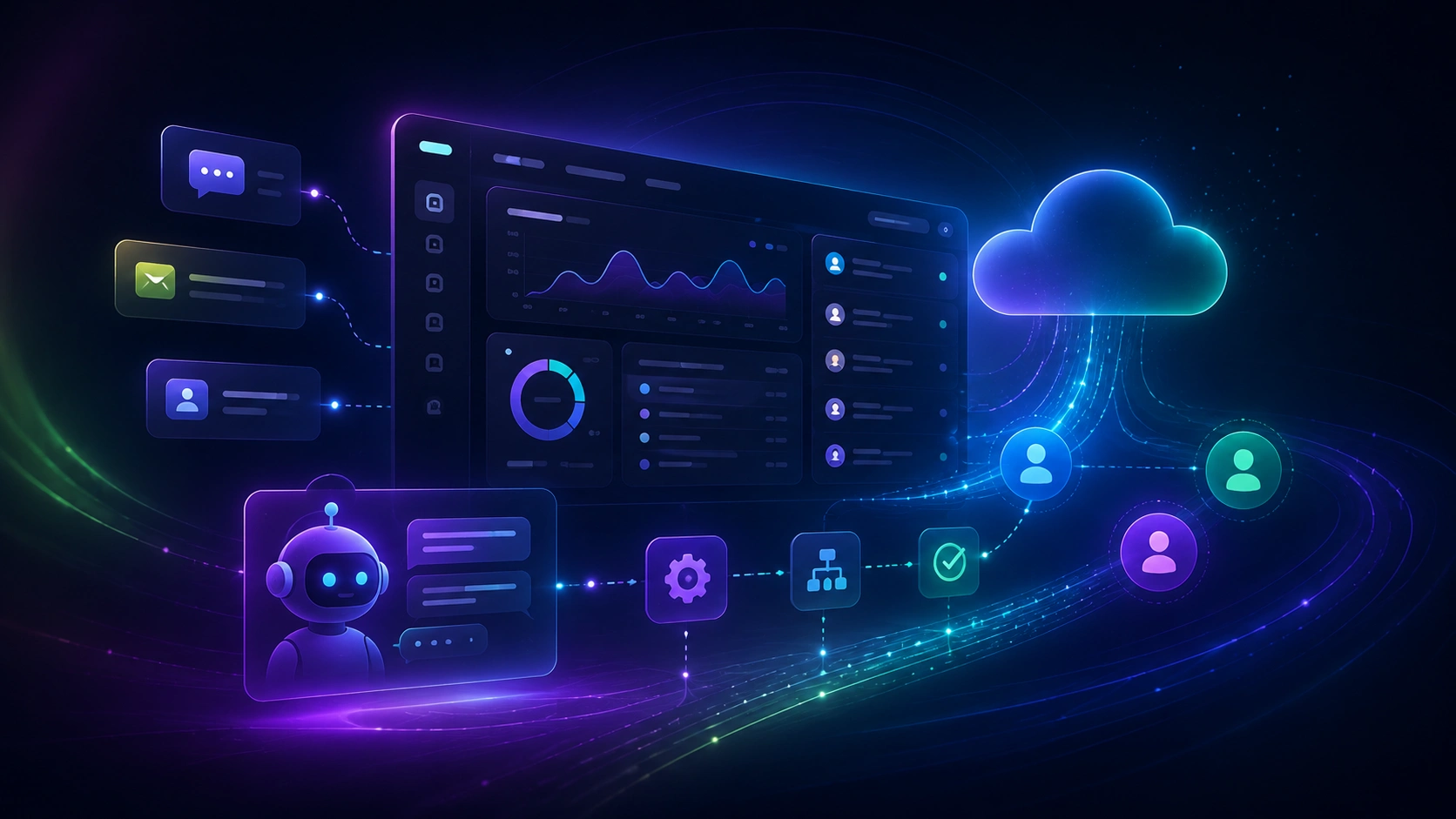
The most important trend behind Freshworks AI SaaS is the movement from AI as a feature to AI as a service layer. In the early stage of enterprise AI adoption, many companies tested features like auto-replies, summaries, and knowledge-base suggestions. Those features were useful, but they were often limited to narrow tasks. Now the market is moving toward AI that sits across workflows and helps coordinate the service experience. This is where the idea of an intelligent service layer becomes powerful.
An intelligent service layer can help connect customer support, IT service management, CRM, asset data, employee requests, and operational insights. That does not mean every company needs one giant system controlling everything. It means businesses increasingly need software that can understand relationships between different service moments. A customer complaint might reveal a product issue, an employee incident might expose a system risk, and a support trend might signal a gap in onboarding or documentation. AI can help surface those relationships faster than manual reporting ever could.
This trend also changes the way companies measure service success. Response time still matters, but it is not the only metric that counts. Resolution quality, customer sentiment, employee satisfaction, workflow health, and operational risk are becoming part of the same conversation. AI-powered SaaS platforms can help leaders see these signals together instead of reviewing them in disconnected reports. That is why the next wave of service software will likely be judged by how well it improves decisions, not just how quickly it processes requests.
Impact on Customer Experience Teams
Customer experience teams may feel the impact of AI service software first because they deal directly with fast-changing expectations. When a customer reaches out, they usually do not care which department owns the answer. They care about whether the company understands the problem, responds quickly, and solves it without forcing them to repeat the same details. AI can help by summarizing previous interactions, recommending relevant solutions, and guiding agents toward responses that fit the customer’s situation. This can make support feel more personal, not less, when it is implemented with care.
The risk, of course, is that companies use AI only to reduce human contact instead of improving service quality. Customers can sense when automation is designed to block them from getting help. That is why the strongest customer experience strategy will combine AI efficiency with human empathy. AI should handle repetitive classification, knowledge retrieval, and simple guidance, while humans focus on judgment, nuance, and emotional context. When that balance works, support teams can move faster without turning the customer journey into a robotic maze.
Freshworks’ broader AI push matters because customer experience is becoming a brand trust issue. A slow or confusing support interaction can damage loyalty even when the product itself is strong. On the other hand, a fast and thoughtful service moment can turn a frustrated customer into someone who stays. For SaaS buyers, this means AI tools are no longer just internal productivity investments. They are part of the brand experience customers remember.
Impact on IT and Employee Experience
IT service teams are also at the center of the AI SaaS shift because internal support has become a major productivity lever. When employees cannot access tools, resolve device issues, or get answers about internal systems, work slows down across the company. These delays may look small in isolation, but they add up when hundreds or thousands of employees experience the same friction. AI-powered IT service management can help by routing requests more accurately, recommending fixes, and creating better self-service pathways. The result can be a workplace where employees spend less time waiting and more time doing meaningful work.
Employee experience is no longer just an HR phrase. It is now closely connected to technology experience, because the quality of internal tools shapes how people feel about their workday. If an employee has to fight with clunky systems to complete basic tasks, frustration grows quickly. If AI can remove repeated admin steps, surface answers, and simplify service requests, the workplace starts to feel lighter. This is why the category around IT service management and employee service platforms is becoming more strategic for SaaS companies.
For Freshworks, this area may be especially important because businesses are looking for service platforms that support both customers and employees. The same principles apply to both groups: people want speed, clarity, and fewer unnecessary steps. AI can help bring those principles into the workflow, but only when paired with strong product design. A system can be intelligent and still fail if users find it confusing. The winners in this category will be the companies that make AI feel useful without making the software feel complicated.
What Business Leaders Should Watch
Business leaders watching this trend should avoid treating AI SaaS as a simple upgrade cycle. The real question is not whether a platform includes AI, because almost every vendor will say yes. The real question is whether the AI improves a measurable workflow that matters to the business. Leaders should look for evidence that a tool can reduce resolution time, improve self-service success, increase agent productivity, or create better visibility across service operations. Without those outcomes, AI can become another expensive layer of complexity.
Another key factor is adoption. A powerful platform that employees avoid will not create transformation. Service teams need AI tools that fit naturally into how they already work, while still encouraging better habits. Training, governance, and internal communication matter just as much as product capability. If teams do not understand when to trust AI, when to review AI output, and when to escalate to a human, the technology can create confusion instead of speed.
Data quality is also critical. AI service software depends on clean knowledge bases, accurate customer histories, organized ticket categories, and reliable internal documentation. If the underlying data is outdated or fragmented, AI may produce answers that sound confident but miss the mark. This is why businesses need to prepare their service architecture before expecting dramatic results. AI can accelerate good systems, but it can also expose messy ones.
Practical Insights for SaaS Buyers
For SaaS buyers, the smartest move is to evaluate AI tools through real use cases instead of broad promises. A customer support team might test whether AI can summarize complex conversations and suggest accurate next steps. An IT team might test whether the platform can classify incidents correctly and recommend proven resolutions. A manager might test whether reporting tools can identify recurring problems before they turn into bigger issues. These practical tests reveal more than a polished demo ever could.
Buyers should also consider how well a platform fits their company size and operational maturity. A startup may need fast deployment and simple automation more than deep enterprise customization. A mid-market company may need better workflow control, stronger integrations, and scalable knowledge management. A larger organization may need governance, role-based permissions, auditability, and multi-region support. The best AI SaaS choice is not always the most complex option, but the one that matches the company’s real stage of growth.
Cost should be viewed through the lens of operational value. If AI reduces repetitive work, improves first-contact resolution, and helps teams serve more users without adding headcount at the same rate, the business case becomes easier to defend. But if a tool adds licensing cost without changing the workflow, the value may be weak. Leaders should ask vendors for clear implementation timelines, success metrics, and examples of how AI is governed inside the product. A strong AI SaaS decision should feel measurable, not magical.
The Competitive Pressure Across SaaS
The Freshworks story also reflects a broader competitive pressure across the SaaS industry. Software companies are being pushed to prove that AI can create real value, not just generate investor excitement or marketing buzz. This pressure affects product roadmaps, pricing models, hiring strategies, and customer expectations. Vendors that move too slowly risk looking outdated, while vendors that move too fast risk shipping features without enough reliability. The balance between speed and trust will define the next phase of SaaS competition.
AI is also changing how SaaS companies explain their value. In the past, a vendor could focus on feature lists, integrations, and workflow coverage. Now buyers want to know how the software learns, how it protects data, how it handles errors, and how it improves over time. They want to understand whether AI is embedded into the product experience or simply added as a separate assistant. This creates a higher bar for product storytelling and customer proof.
For a site like SaaS Vortixel, this is exactly the kind of shift worth tracking because it shows where software business models are going next. The SaaS industry is no longer only about cloud delivery and subscription pricing. It is increasingly about intelligent systems that help companies operate with more speed and less friction. Freshworks is part of that larger movement, and its AI service strategy highlights how deeply the category is changing. The companies that win will be the ones that make AI practical enough for everyday teams, not just impressive enough for conference stages.
Challenges Freshworks and AI SaaS Still Face
Even with strong momentum, AI SaaS still faces serious challenges. Trust remains one of the biggest issues because businesses cannot afford service tools that produce inaccurate answers or mishandle sensitive information. Customer support and IT environments often contain private data, internal system details, and context that must be protected carefully. Any AI feature operating in that space needs strong controls, transparent permissions, and clear human review options. Without that foundation, adoption may slow down no matter how promising the technology looks.
Another challenge is change fatigue. Many teams have already gone through multiple software migrations, automation projects, and digital transformation plans. When a company introduces AI, employees may worry that it will create more monitoring, more complexity, or even threaten their roles. Leaders need to frame AI as a workflow improvement tool and support teams through the transition. If the human side of implementation is ignored, even a strong platform can struggle to gain trust.
There is also the question of differentiation. As more SaaS vendors add AI features, buyers may find it harder to tell which products truly offer value. Freshworks will need to keep showing how its AI strategy connects to outcomes in customer experience, IT service, and employee productivity. The market will reward clarity because decision-makers are becoming more skeptical of vague AI claims. In this environment, simple, reliable, and measurable service transformation may be more powerful than chasing every new AI trend.
Why This Moment Matters for the Future of Work
The future of work will not be defined only by remote tools, productivity apps, or collaboration platforms. It will also be defined by how quickly people can get help when something blocks them. A customer needs an answer, an employee needs access, a manager needs visibility, and a technical team needs a faster way to resolve incidents. Service software sits behind all of those moments. When AI improves that layer, the effect can spread across the entire business.
This is why the Freshworks AI SaaS push feels bigger than one company’s product strategy. It points to a future where service platforms become more proactive, more contextual, and more connected to business outcomes. Instead of waiting for problems to pile up, companies can use AI to understand service signals earlier. Instead of asking teams to manually sort through repeated issues, software can help reveal what needs attention. Instead of forcing users through slow processes, SaaS tools can guide them toward faster resolution.
The human side still matters most. AI can summarize, classify, recommend, and automate, but trust is built when people feel heard and problems are actually solved. The best service software will not remove humans from the equation. It will help humans spend more time on work that requires empathy, judgment, creativity, and accountability. That is the version of AI SaaS that businesses should be aiming for.
Conclusion: Freshworks AI SaaS Signals a Smarter Service Future
Freshworks AI SaaS represents a larger turning point in the software industry, where AI is moving from experimental feature to practical service engine. Businesses are no longer satisfied with tools that only organize work after it arrives. They want platforms that can understand context, reduce repetitive effort, improve response quality, and help teams act before problems grow. Freshworks is stepping into that moment by focusing on service transformation for customer experience, IT support, and employee workflows. The real opportunity is not just faster automation, but smarter service that feels more useful for both teams and the people they support.
As AI continues reshaping SaaS, the winners will be the companies that make intelligence feel simple, safe, and measurable. Freshworks has a strong lane because service software is one of the clearest places where AI can create immediate value. The pressure now is to keep turning that promise into everyday outcomes that customers can see and teams can trust. For business leaders, the lesson is clear: AI should not be adopted just because it is trending. It should be adopted when it helps people solve real problems faster, better, and with less friction.